
Crossing the Styx
What a South Carolina fish hatchery taught me about thresholds, truth, and advisory work

An Origin Story
I grew up on a fish hatchery in South Carolina.
It was called Styx.
For most of my childhood, that name didn’t mean anything to me beyond geography. It was simply where I lived — warm-water ponds stitched together by dirt roads, bass and bream moving just below the surface, algae blooming in the summer heat. My father worked there as Hatchery Manager. The hatchery raised fish for the state.
Water came in, water went out. Life moved through it.
Only later did I learn that the River Styx is also the most famous river in Greek mythology — the boundary between the world of the living and the world of the dead.
In myth, you don’t “drift” across the Styx. You cross it deliberately. You pay a fare. You leave something behind. And once you cross, you are changed.
That coincidence — the Styx of my childhood and the Styx of mythology — has come to feel less accidental over time.
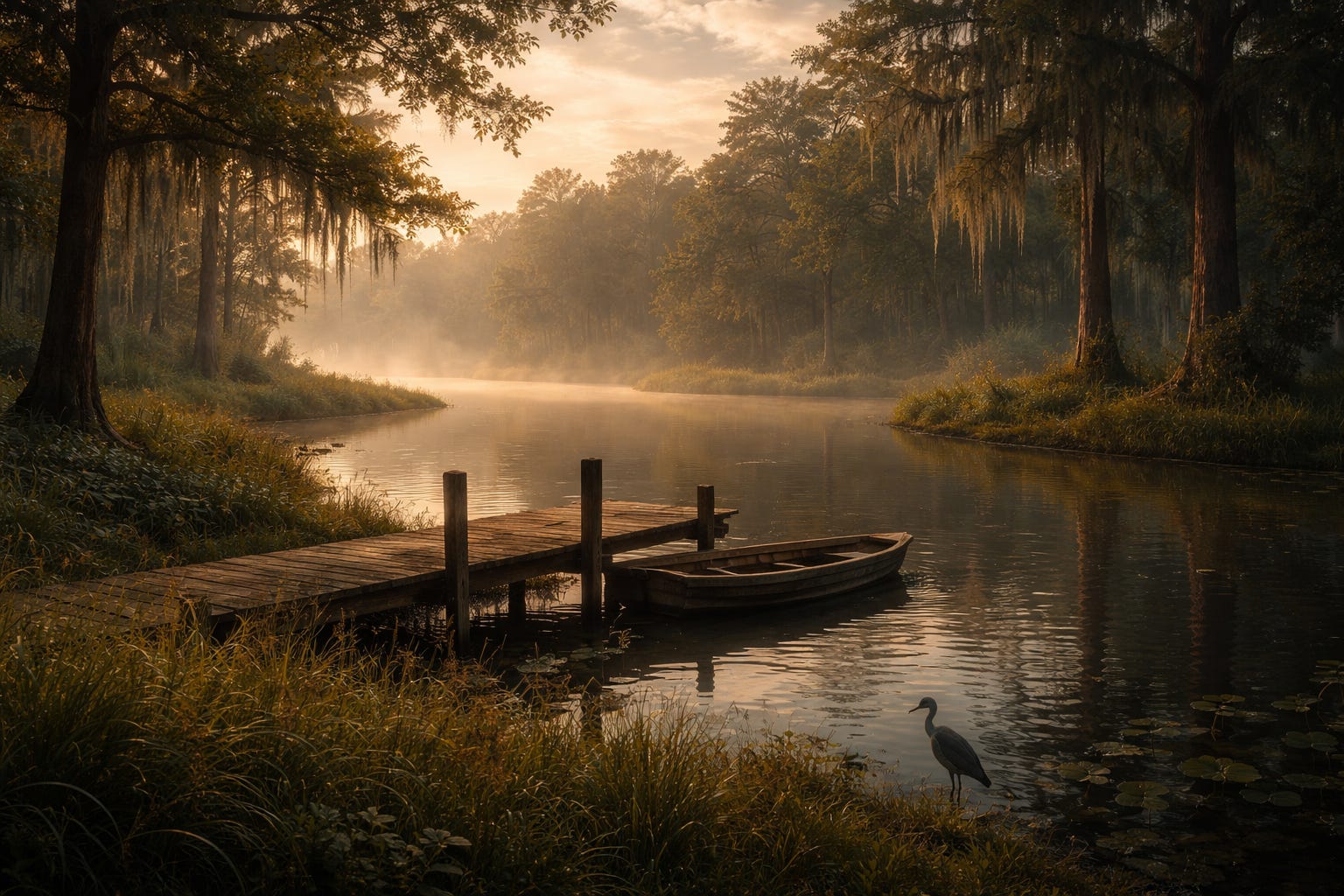
The River Styx: The One You Don’t Cross Lightly
In Greek mythology, the Styx runs through the Underworld. Souls require a ferryman— someone to take them to the other side — and a coin to cross. Without it, souls remain stranded, neither here nor there.
The river is not evil, but it is absolute. It marks a line that cannot be undone.
Even the gods feared it.
The Olympians swore their most binding oaths on the Styx. To speak falsely upon its waters was to invite exile, collapse, and disgrace — even for immortals. The Styx was not about punishment. It was about consequence. About truth enforced by reality itself.
That is what rivers do.
They divide.
They carry.
They force decisions.
Growing Up on a Working River
The Styx I knew as a child wasn’t mythic. It was ecological.
It was a warm-water facility — ponds, not concrete vats. Bass and bream, not trout. Shallow water that changed with the seasons. Muddy banks. Long mornings watching the surface instead of machinery.
Water moved slowly there, but it mattered just as much.
If the oxygen dropped, the fish surfaced gasping. If the balance was off, the whole pond went quiet. Nothing announced failure with alarms or gauges — you learned to read signs. Color. Smell. Stillness. The absence of movement.
It taught me early that systems don’t always break loudly. Sometimes they drift. Sometimes they stagnate. And by the time collapse is visible, the damage is already done.
That environment shaped how I understand risk — not as something mechanical, but as something ecological. Interconnected. Lagged. Unforgiving of denial.
Advisory Work as a “Crossing”
In my experience, the hardest moments for institutions — governments, NGOs, investors, families — are not moments of growth. They are moments of transition.
When a park moves from protection to productivity.
When conservation moves from vision to finance.
When capital moves from intention to risk.
When leadership moves from control to trust.
These moments feel uncertain because they are thresholds. They require crossing from what was to what must be. And too often, advisory work pretends these crossings are purely technical.
They are not.
They are moral, cultural, financial, and human crossings all at once.
That is where advisory work has failed in the past — and where I hope to do it differently.
What It Means to Cross the Styx Well
To cross the Styx is to accept that:
Not everything comes with you
Oaths matter
Systems remember
Shortcuts cost more later
Good advisory work is not about selling certainty. It is about helping people cross thresholds honestly — eyes open, incentives aligned, tradeoffs acknowledged.
It means respecting constraints instead of hand-waving them away.
It means telling the truth early, not late.
It means understanding that once capital crosses a line — into a landscape, a community, a balance sheet — it changes what it touches.
In mythology, Achilles gained near-invulnerability from the Styx but remained mortal. Power never comes without exposure. Every structure has a weakness.
The job is not to pretend otherwise.
The job is to name it.
Why I Named the Firm Styx
I didn’t choose the name Styx because it sounds dramatic.
I chose it because this work lives at boundaries:
Between conservation and capital
Between ambition and stewardship
Between what people want to believe and what is actually true
The river doesn’t judge. It simply flows. It reflects back whatever crosses it.
That is the kind of advisor I want to be.
Someone who helps clients cross difficult terrain with clarity, humility, and respect for the forces involved—natural, financial, and human.
Because once you cross the Styx, there’s no going back.
And that’s exactly why it matters how you cross it.